.png)
Ask an AI assistant a detailed question in your field and watch where the answer comes from. It usually pulls from people who clearly did the work, not from the tidiest article ranking for the keyword. That pattern is consistent enough that it's worth understanding, because it explains where content is heading.
The reason is that AI systems need things they can attribute. A practitioner gives them facts, numbers, and specific claims tied to a name. An SEO article often gives them a summary of what everyone else already said, and a summary of the crowd has no reason to be quoted.
What These Systems Are Actually Looking For
When an AI assistant builds an answer, it pulls pieces from sources it treats as trustworthy and puts them together. The pieces it wants are specific claims, because a general statement adds nothing to an answer the model could already write itself.
So the useful question isn't how to write for AI. It's what kind of writing gives a machine something to take. A sentence like “customer retention is important for growth” gives it nothing, since the model knows that. A sentence like “when we moved onboarding calls from day seven to day one, cancellations in the first month dropped by a third” gives it a fact with a source attached.
Practitioners write the second kind naturally, because they're describing what happened to them. SEO writers researching a topic they haven't lived usually can't, since the specifics were never theirs to know. That gap is the whole story.
The Flood That Changed Everything
Content stopped being scarce, and that reset what counts as valuable. Graphite's analysis of 65,000 pages found that around half of new articles published on the web are now mainly AI-generated.
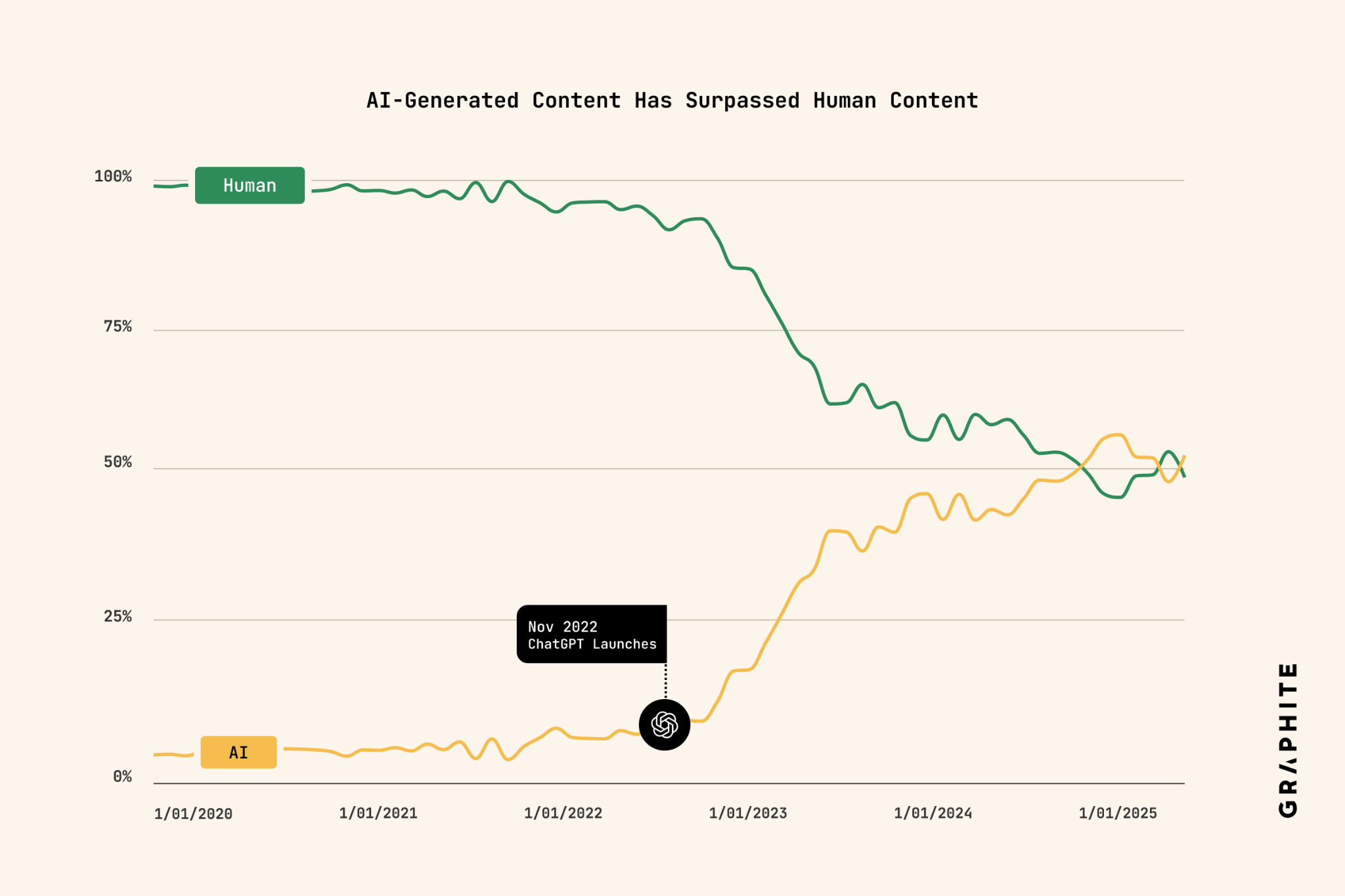
When anyone can produce a thousand competent articles a week, competent articles stop being worth much.
What stayed scarce is anything that required doing something. Running the campaign, managing the team, fixing the broken process, surveying your customers. Those experiences can't be generated, only reported, and both readers and machines have gotten good at telling the difference. The same research found that despite AI producing half of new content, 86% of the articles actually ranking in Google are still human-written, which tells you how the filtering is going.
This is why the old content playbook feels weaker every quarter. Researching what ranks and rewriting it better used to work, since better organization was a real contribution. Now it's the exact thing AI does faster, and doing it manually just means losing more slowly.
Why Machines Trust People Who Are Cited Elsewhere
There's a second layer beyond the writing itself. AI systems weigh whether other sources back you up. A person quoted in several publications about the same topic looks like a safer thing to repeat than a person whose only claim to expertise is their own website.
This part is uncomfortable for anyone who built authority purely on their own domain. You can write brilliantly on your blog for years and stay invisible to these systems, because nothing outside your site confirms you. Meanwhile someone with a thinner website and twenty expert quotes across real publications gets named constantly.
It's not fair exactly, but it is logical. The machines are doing what a careful person does, which is checking whether anyone else vouches for you before repeating what you said.
What SEO Writers Still Do Better
Worth being fair here, because this isn't a takedown. Good SEO writers organize information clearly, structure pages so answers are easy to find, and cover topics completely. Those skills still matter, and plenty of experts are terrible at all three.
The strongest content usually comes from combining them. A practitioner supplies the specifics, and someone with structure skills makes sure each answer sits in a clean, self-contained block a machine can lift. Neither half wins alone. An expert's insight buried in a wall of text gets skipped, and perfect structure wrapped around nothing gets ignored. The same pairing wins in media pitches too.
So the shift isn't that writing stopped mattering. It's that writing without real experience behind it stopped being enough, which is a fairly reasonable place for things to land.
What This Means for How You Publish
A few things change once you take this seriously. Put the practitioner's name and credentials on the content, since attribution is part of what makes a claim usable. Include the specifics you'd normally smooth out, the actual numbers, the timeline, the thing that went wrong before it went right.
Then get those specifics into places other than your own site, because outside confirmation is the part your blog can't provide for itself. Answering journalist queries is the cheapest way to do that, since it costs time instead of budget and puts your name in publications you couldn't buy into. For newer sites with no authority yet, this order matters more than anything else.
The Test That Tells You Which Side You're On
Take any article you published recently and read it looking for one thing. How many sentences contain something that could only come from your actual experience? Not opinions, not summaries of research, but facts from work you did.
If the answer is zero, an AI system has no reason to cite that page over any other page on the topic, no matter how well it ranks today. If the answer is five or six, you've written something that can be quoted, referenced, and repeated, which is what visibility looks like now. Fixing that ratio does more for your long-term visibility than another round of keyword work.
Wrapping Up
AI systems prefer real experts because experts produce facts worth attributing, and because the rest of the web confirms they exist. SEO writing lost ground for the opposite reasons, since summarizing available information is now free and self-declared authority convinces nobody, human or machine.
The fix isn't complicated, though it does require doing the work first. Publish what you actually learned, keep the details in, put your name on it, and get quoted in places that aren't yours. That's what being a real expert looks like from the outside, which happens to be the only view these systems have.
FAQs
1. Does this mean SEO writing is dead?
No, but it can't stand alone by itself now. Structure, clarity, and topic coverage still help pages get found and understood. What stopped working is content built only from other people's information, since AI produces that instantly and neither readers nor machines have a reason to prefer yours.
2. How do AI systems know someone is a real expert?
Mostly through two signals. First, whether the writing contains specific, attributable claims instead of general statements. Second, whether other trusted publications mention that person in connection with the topic. Neither one is about your website design or your keyword usage.
3. Can I add expertise to content I already published?
Yes, and it's usually faster than writing new pages. Go through your best articles and add the specifics you originally left out, real numbers, actual examples, what went wrong. Add a proper author byline with credentials. That upgrade often outperforms publishing three new posts.
4. What if I'm a writer, not a practitioner?
Interview practitioners and quote them properly, with names and titles. That turns your article into a source of attributable claims instead of a summary. Many of the strongest pages in any field are written by skilled writers who did the work of getting real people on the record.
5. How long does it take for AI systems to notice my expertise?
Usually months, since these systems learn from repeated mentions across sources instead of any single page. Consistent quotes in your specific topic area move the needle faster than scattered coverage. Check monthly by asking assistants your customers' questions and noting which brands appear.


.png)