
If you’re trying to land real media coverage for your brand, two platforms show up in every conversation: HARO and Qwoted. Both let you pitch expert quotes to journalists to help you get featured in relevant media.
HARO pulls in high-volume, mixed-industry reporters because of its long history and open style, while Qwoted leans toward more curated, profile-driven workflows that many business and finance writers prefer.
This guide breaks down how HARO and Qwoted actually work in 2026, what’s changed over the years, how each platform sources journalists, and which one gives you a better shot at meaningful, trustworthy media exposure as a founder, marketer, or CEO.
Make sure to stick around.
So What is HARO (and How It Got Here)
Image source: Helpareporterout.com
HARO started in 2008 as a simple Facebook group. Its creator was Peter Shankman, a PR veteran and entrepreneur, who wanted a way to help reporters connect with expert sources. Very quickly, the idea grew. By March 2008, HARO was turned into an email newsletter with roughly 200 members.
By 2009, the numbers exploded: HARO had about 30,000 journalists and 80,000 sources, with 150–200 journalist queries coming in each day. It was still free for users, and it made money by selling ads in those daily emails.
In June 2010, HARO was acquired by Vocus, a PR-software company. Then in 2014, Vocus merged with Cision, making HARO part of one of the largest media intelligence firms in the world.
In late 2024, Cision rebranded HARO as Connectively, but also announced that Connectively would be discontinued on December 9, 2024, as part of a shift to focus on their core product suite.
😀 All hopes lost, until…
HARO’s Acquisition by Featured.com
Source: Featured.com
In April 2025, HARO’s story took a big turn: Featured acquired HARO.
Featured, which rebranded from its former name Terkel, runs a platform that connects subject-matter experts with journalists, so acquiring HARO was a very natural fit.
Brett Farmiloe, Featured’s CEO, said the goal was to bring HARO back to its original email-digest style while modernizing it to fight off spam and AI-generated low-value pitches.
Importantly, Featured relaunched HARO as free for both sources and journalists, supported by newsletter ads.
So how does HARO work now and is it the same HARO we all used to love?
How HARO Works Today?
Under Featured’s ownership, HARO has returned to the classic email newsletter format. When journalists submit a query, it gets sent out in a daily digest (morning, afternoon, evening) to registered experts.
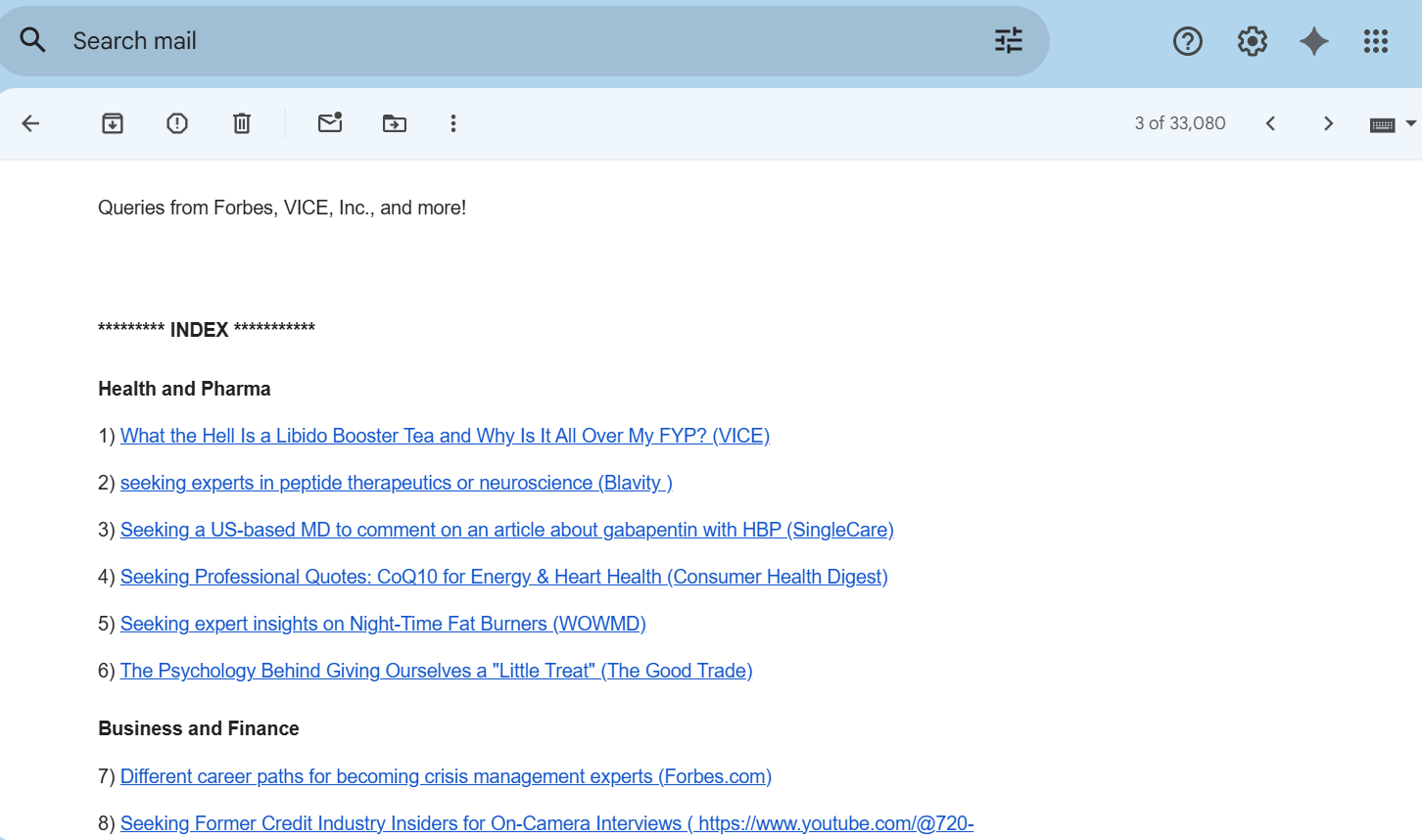
HARO daily email.
You reply by email like before (thankfully, no clunky dashboard required, like we already don’t have them a lot 😀).
So the first relaunch email went out on April 22, 2025.
Featured has also put a new energy into quality control: they’re focused on reducing spam and AI-only replies by using more manual vetting and smarter filters. All of this is part of Featured’s mission to ‘unlock expert knowledge’ and keep media conversations rooted in real human insight.
But for any platform, there are always goods and bads we need to discuss more openly, so you can make the right decision.
Strengths & Weaknesses of HARO
Here are some of the things I personally like & dislike about HARO based on our years-long golden-era experience and the-now experience of using it.
Strengths
- Free to Use: Both journalists and experts can participate without cost.
- High Volume of Queries: Since it’s email-based and open to many categories, you’ll get a constant stream of media outreach opportunities.
- Familiar Format: Featured brought back the classic morning/afternoon/evening email digests, which makes it easy if you used old HARO.
- Credibility Focus: Featured is very explicit about wanting real human voices, and is working on reducing spam and AI-only replies. Like their official platform, they likely have an AI spam filter installed.
- Community Reactivation: Featured reactivated many users from the old HARO lists — so there’s continuity and some existing relationships have been restored.
Weaknesses
- Potential for Spam / Low-Quality Pitches: Even with better moderation, the open nature of HARO still means you may receive or see low-effort responses.
- Inbox Overload Risk: Receiving three digests a day means you’ll need to filter effectively and need to be on top of things. Otherwise, the volume might become overwhelming over time.
- Old User List Limits Diversity: While Featured reactivated old subscribers, there's a risk that the “old guard” dominates and that newer, diverse voices might not get as much attention early on.
- Dependence on Newsletter Ads: Because the business model is based on email ads, platform sustainability depends heavily on ad revenue, which could influence how many resources go into improving features or vetting (further risking the platform’s growth).
- Delay in Rebuilding Trust: Journalists and sources who were burned by Connectively or low-quality responses may be cautious. Featured has to rebuild that trust gradually.
What is Qwoted? An Overview
Qwoted isn’t a new kid in the PR world. It was founded in 2018 in New York City by Daniel P. Simon and Matthew Kneller.
They found a gap in the market: make it even easier for journalists to find real experts without the noise, spam, and chaos that email-based platforms create.
Over the years, it has grown into a full communication-tech platform used by founders, marketers, PR specialists, and industry experts who want predictable, organized media outreach.
The platform didn’t stop at matching experts either. In 2023, Qwoted added networking features so PR pros and communication teams could connect with each other directly. As of that update, the platform had more than 100,000 PR users, which shows how much it’s expanded since its early days as a simple request board.
How Does Qwoted Work?
When you join Qwoted, the first step is setting up a detailed expert profile. This includes your bio, areas of expertise, company details, social links, past press mentions, and the topics you want to be quoted on. (Sensitive client info hidden)
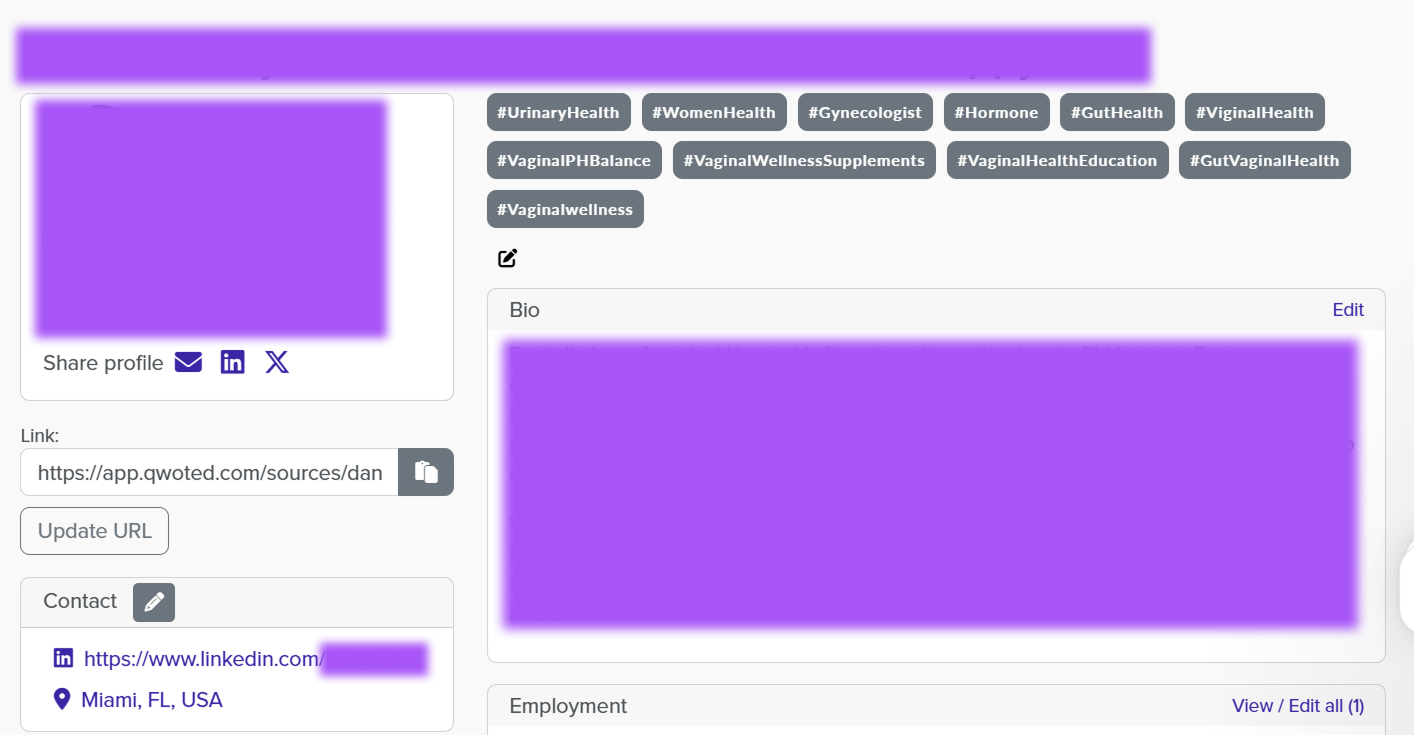
Source: Qwoted.com
Your profile is what journalists use to discover you, so the more complete and specific it is, the higher your chances of getting noticed.
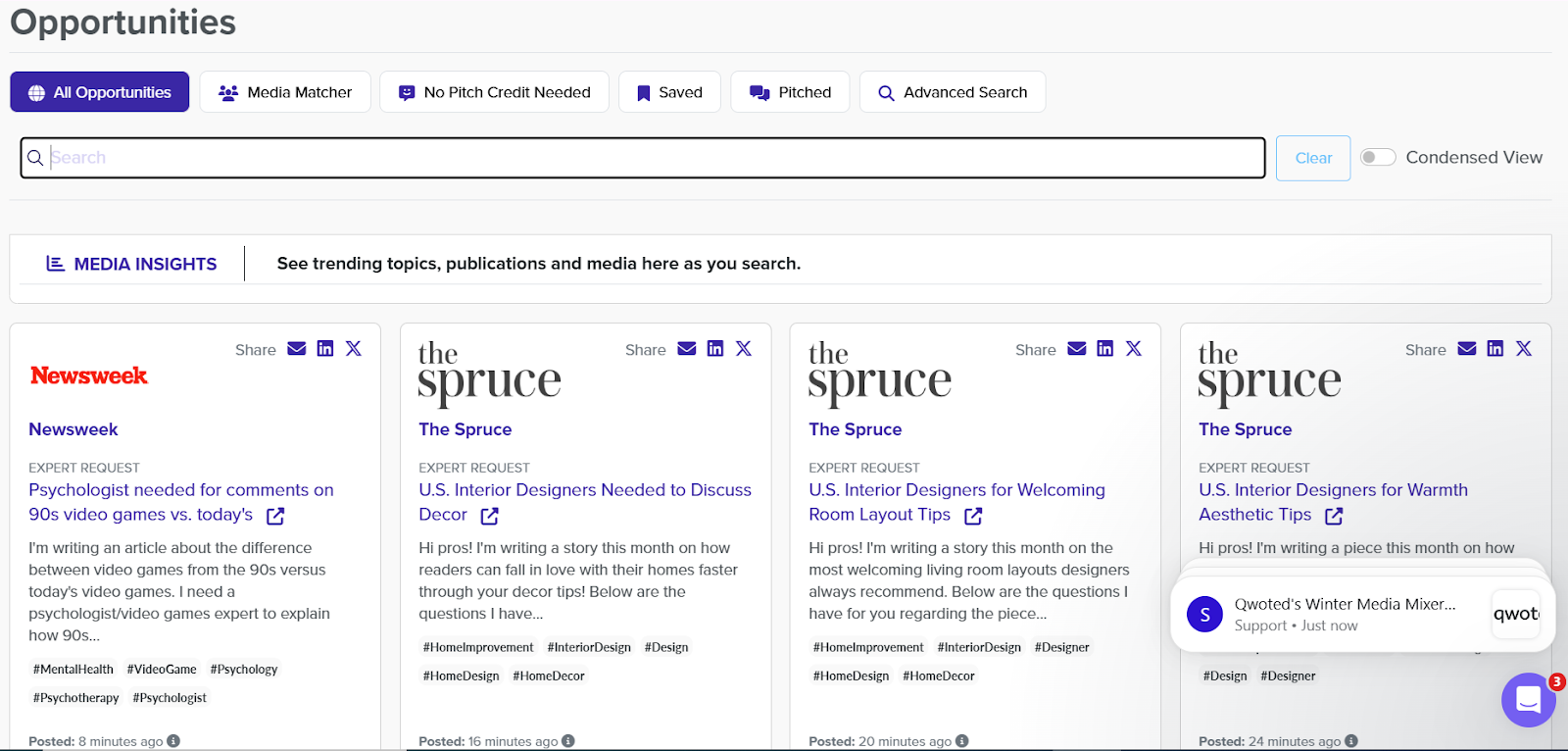
Journalists submit Requests through the platform, specifying the story angle, publication, type of expertise needed, deadline, and whether the request is editorial or paid. This transparency ensures you know exactly what the journalist is looking for before pitching.
Qwoted uses a combination of topic matching, tags, categories, and natural language processing to pair Requests with relevant expert profiles.
Source: Qwoted.com
Once matched, you respond directly through Qwoted’s internal inbox. Journalists view and filter responses inside the platform, keeping your pitch organized and separate from crowded email threads. This approach avoids the chaos of mass email systems like HARO.
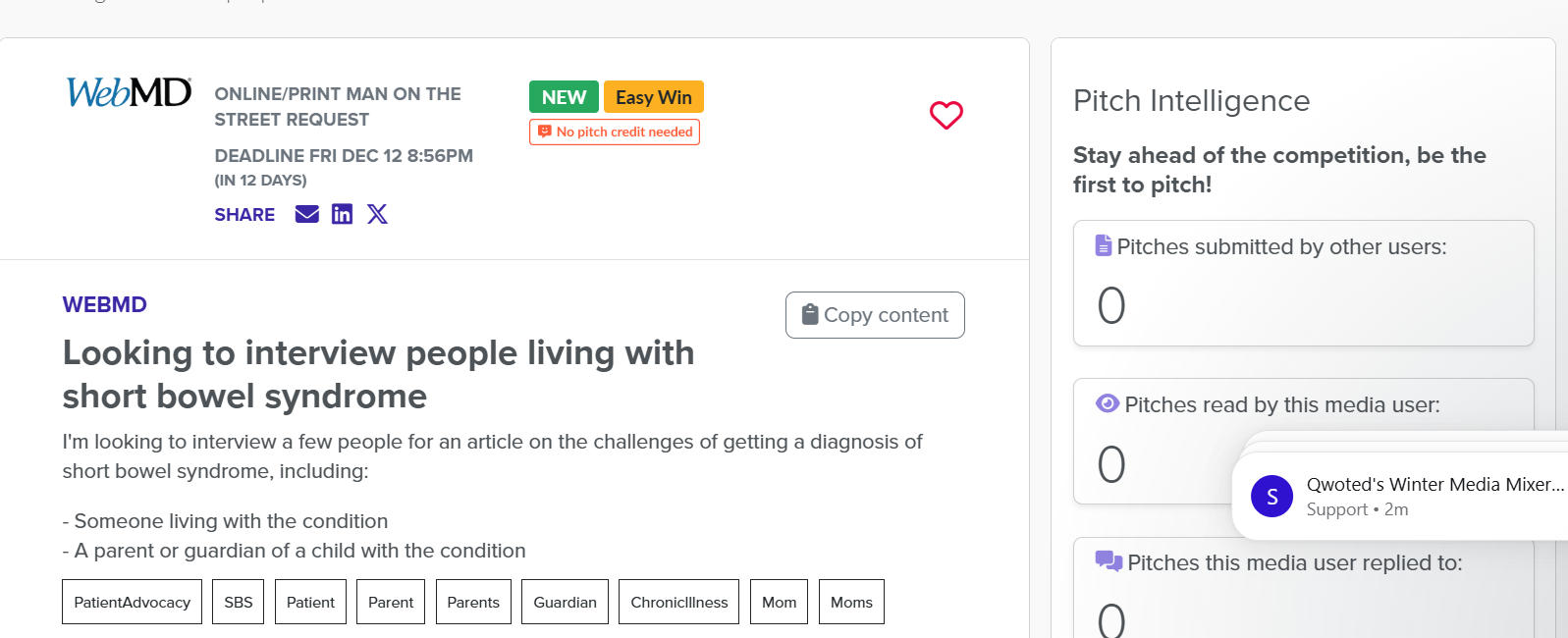
Qwoted gives you a unified dashboard where you can track which journalists have viewed your pitch, who has responded, and which Requests are still active.
Source: Qwoted.com
This allows you to manage multiple opportunities efficiently, follow up on leads, and maintain visibility without relying on external tools.
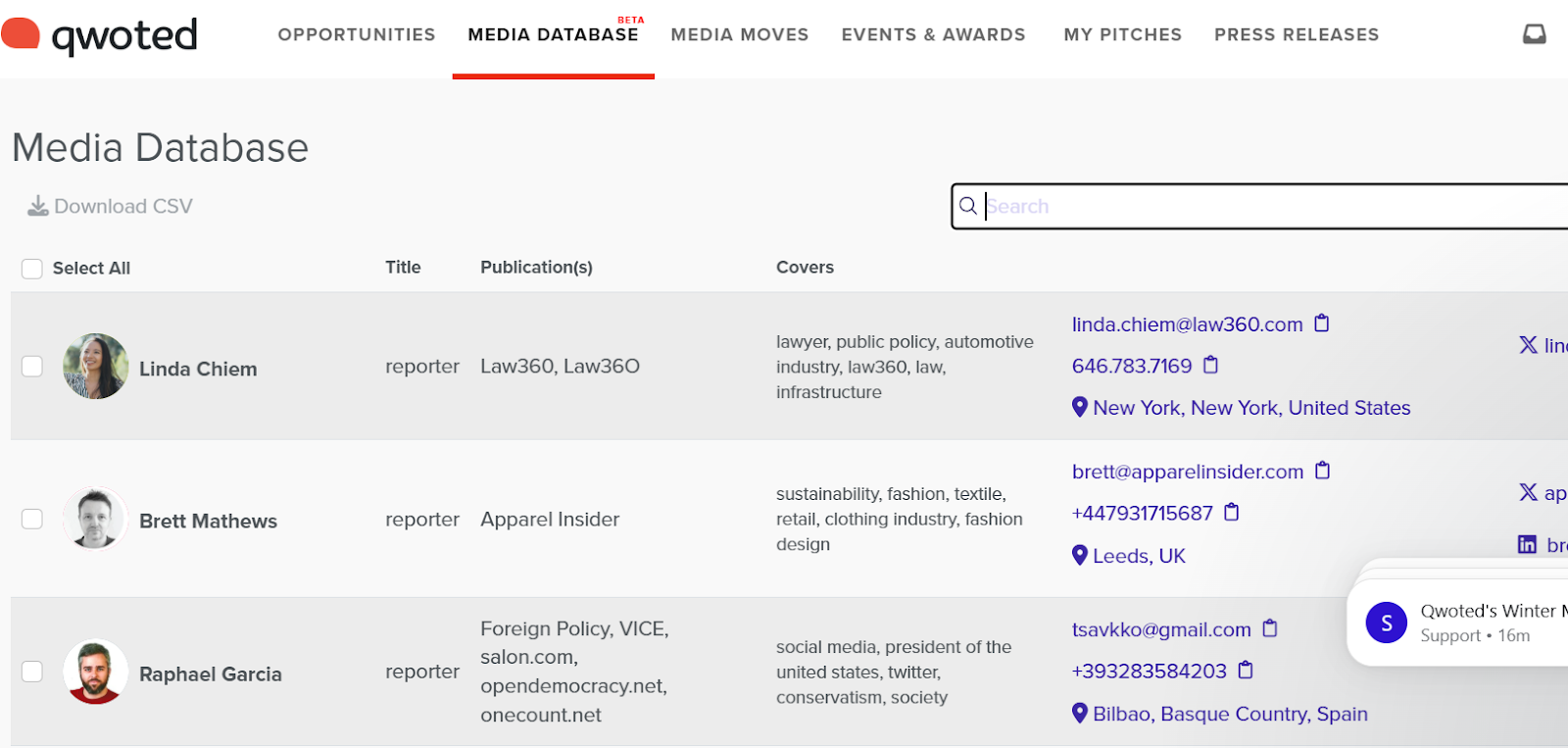
There’s also a media sources database that you can use to directly communicate with reporters. Though it’s still in BETA phase at the time I’m writing this.
Source: Qwoted.com
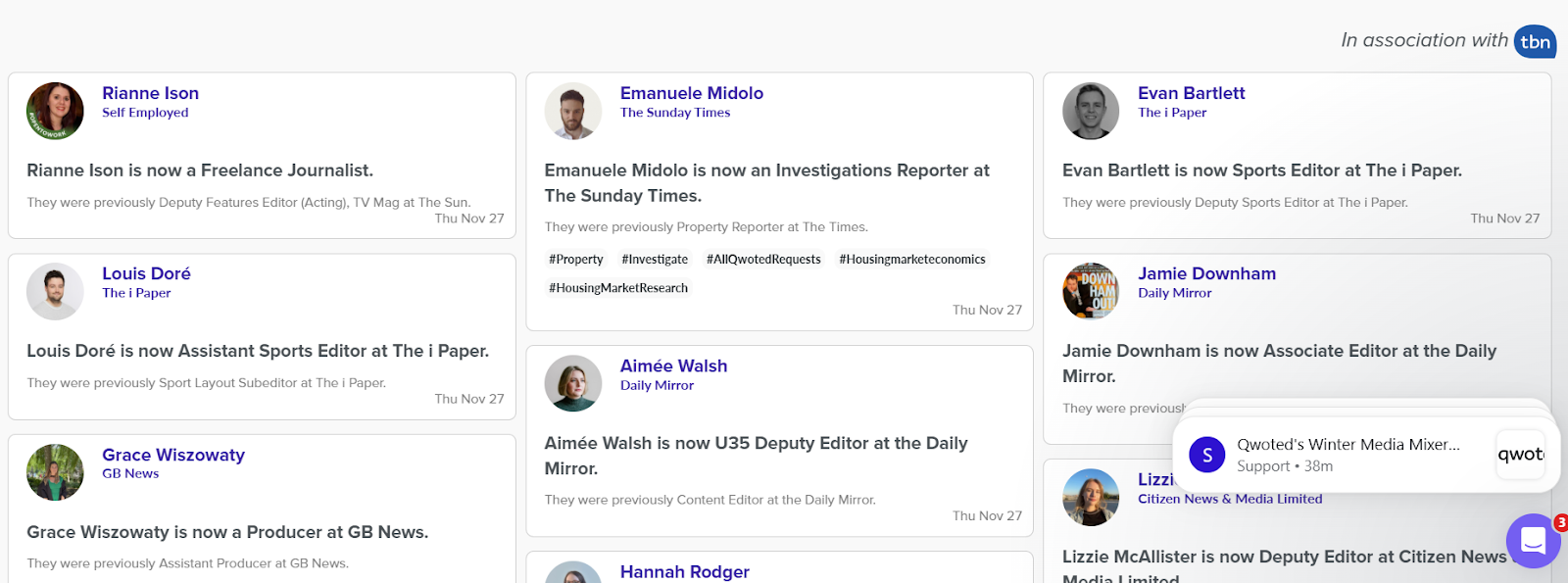
On top of it, they also have this ‘Media Moves’ tab where they show where reporters have moved to, if they have changed jobs at different media publications for example.
Which I think it’s a nice-to-have, since over time you build a good connection with certain reporters and they can prefer you as you wish to pitch to certain media outlets.
Source: Qwoted.com
Strengths & Weaknesses of Qwoted
Here are some pros and cons of the Qwoted platform from personal experience.
Strengths
- Curated Matching: Qwoted filters out irrelevant responses by matching journalist queries with expert profiles. That works mostly well, and reduces the random spray-and-pray pitching that kills conversion rates.
- Centralized Communication: Everything happens inside Qwoted. No inbox clutter, no messy threads, and no digging for deadlines. You track pitches, replies, and journalist responses in one place.
- Strong PR Community: Since 2023, Qwoted has built out networking tools, and over 100,000 PR professionals use the platform. This community effect gives it more credibility and activity than smaller HARO alternatives.
- Better Experience for Journalists: Reporters receive filtered expert replies rather than being buried under hundreds of irrelevant emails. Qwoted also has this AI-filter that tells the AI score of an expert's pitch, meaning they can easily pick a human written response if they wish to. (Happy journalists = platform’s growth in most cases😀).
- No-Credit Opportunities: Insider your paid opportunities dashboard, there are also some articles that require no pitch credit.
Weaknesses
- Not Fully Free for Everyone: Sources can join for free, but are only limited to 2 pitches/mo and get 2 hours delayed opportunities. Meaning, it’s not as open or accessible as HARO’s free email digest model.
- Slower If You're New: If your expert profile is new or unestablished, landing your first few features may take time since Qwoted’s system prioritizes relevance and completeness (and journalists usually, too).
- Lower Query Volume than HARO: Qwoted gets steady journalist requests, but because it’s more curated, the volume is naturally lower than mass-digest platforms like HARO.
- Learning Curve for Beginners: The dashboard is great, but for someone used to “just reply to an email,” it takes a bit of getting used to.
Pricing Comparison: HARO vs Qwoted
HARO used to have paid plans in the old Vocus/Cision era, but those no longer apply. When Featured.com acquired HARO in April 2025, they brought the platform back as HARO email digest. Both journalists and experts can use HARO without paying anything. The business model now depends on newsletter sponsorships, not subscription tiers.
Qwoted works differently. You can join for free, but the free plan only lets you send two pitches per month and shows new journalist requests with a delay. The paid plans unlock immediate access to opportunities, more pitch credits, profile boosts, and priority visibility inside the platform. It’s the more structured and premium-driven model between the two.
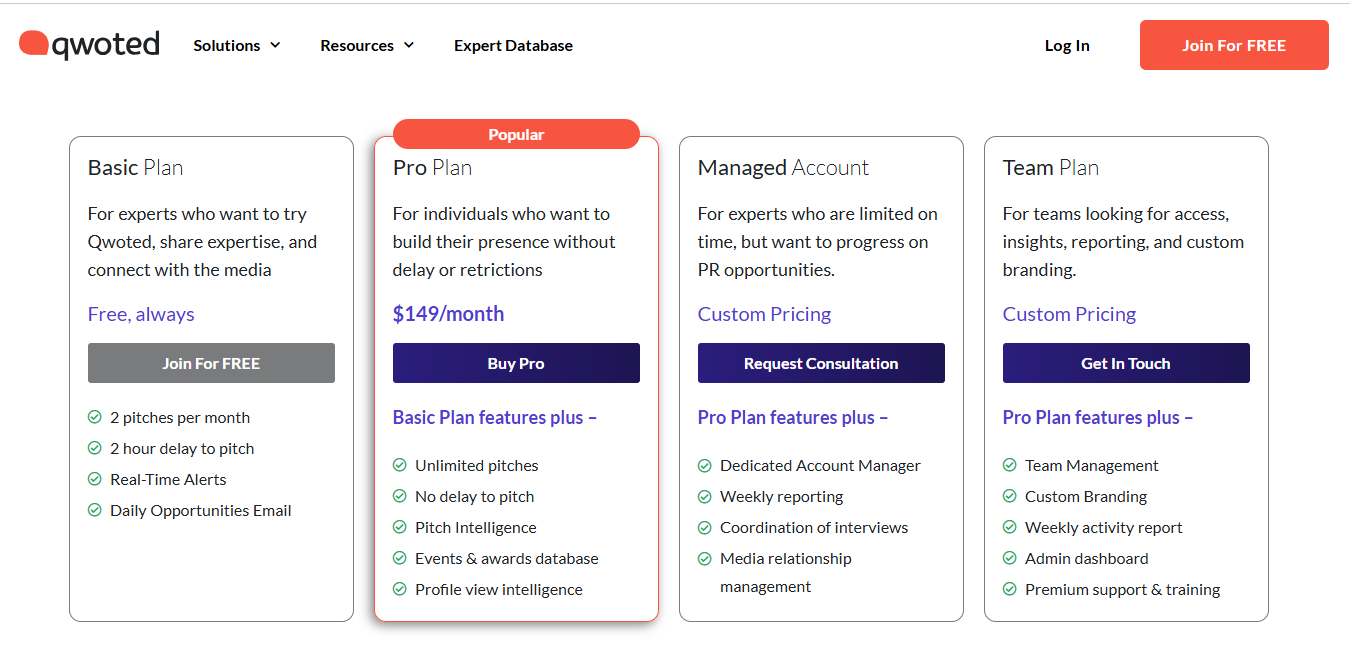
Image Source: Qwoted.com
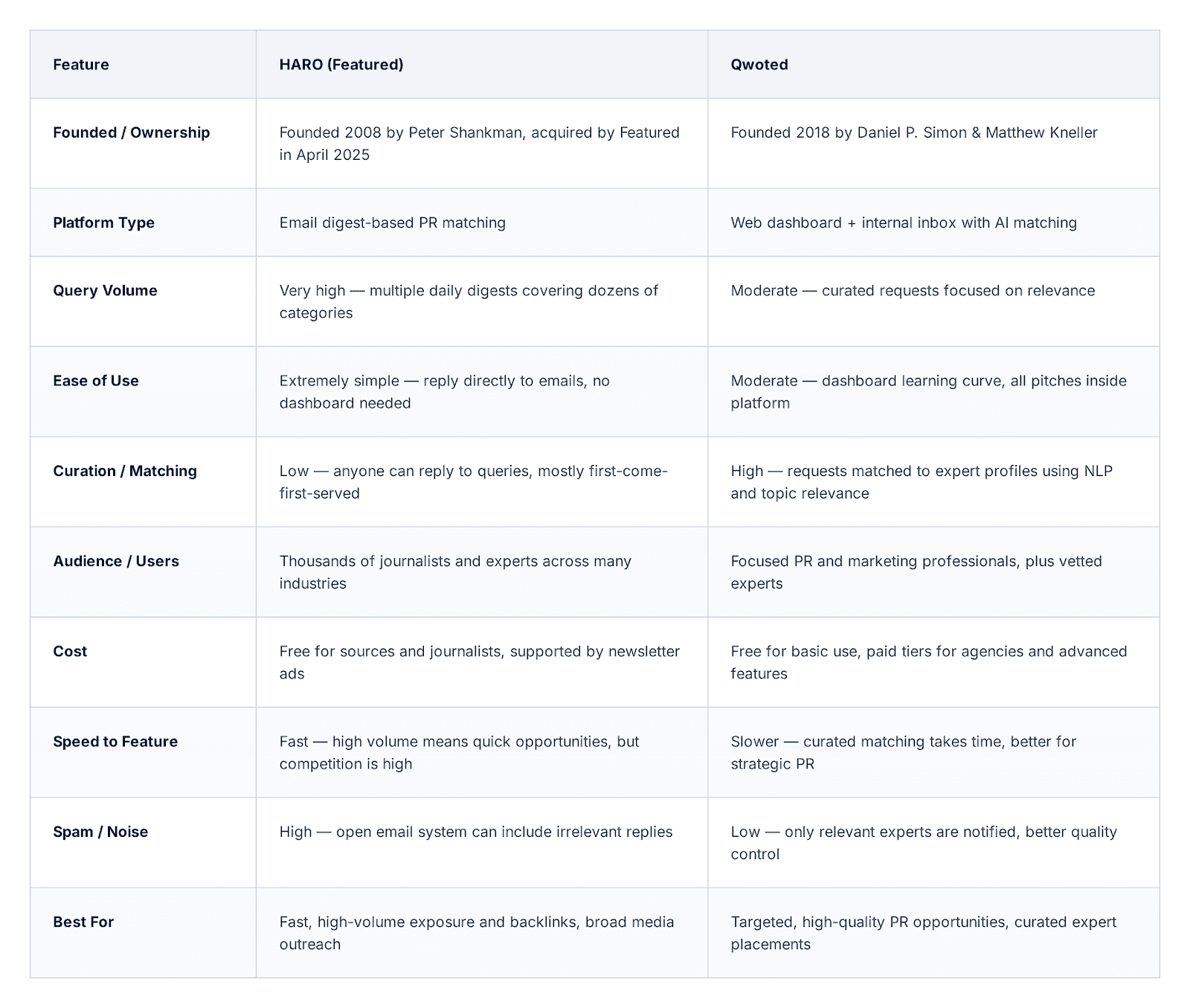
Side by Side Comparison of HARO & Qwoted (Table)
PR & Media Outreach Trends in 2026
The PR landscape in 2026 looks very different from even a few years ago. Technology, changing journalist workflows, and evolving audience behavior are shaping how founders, marketers, and PR professionals need to approach media outreach.
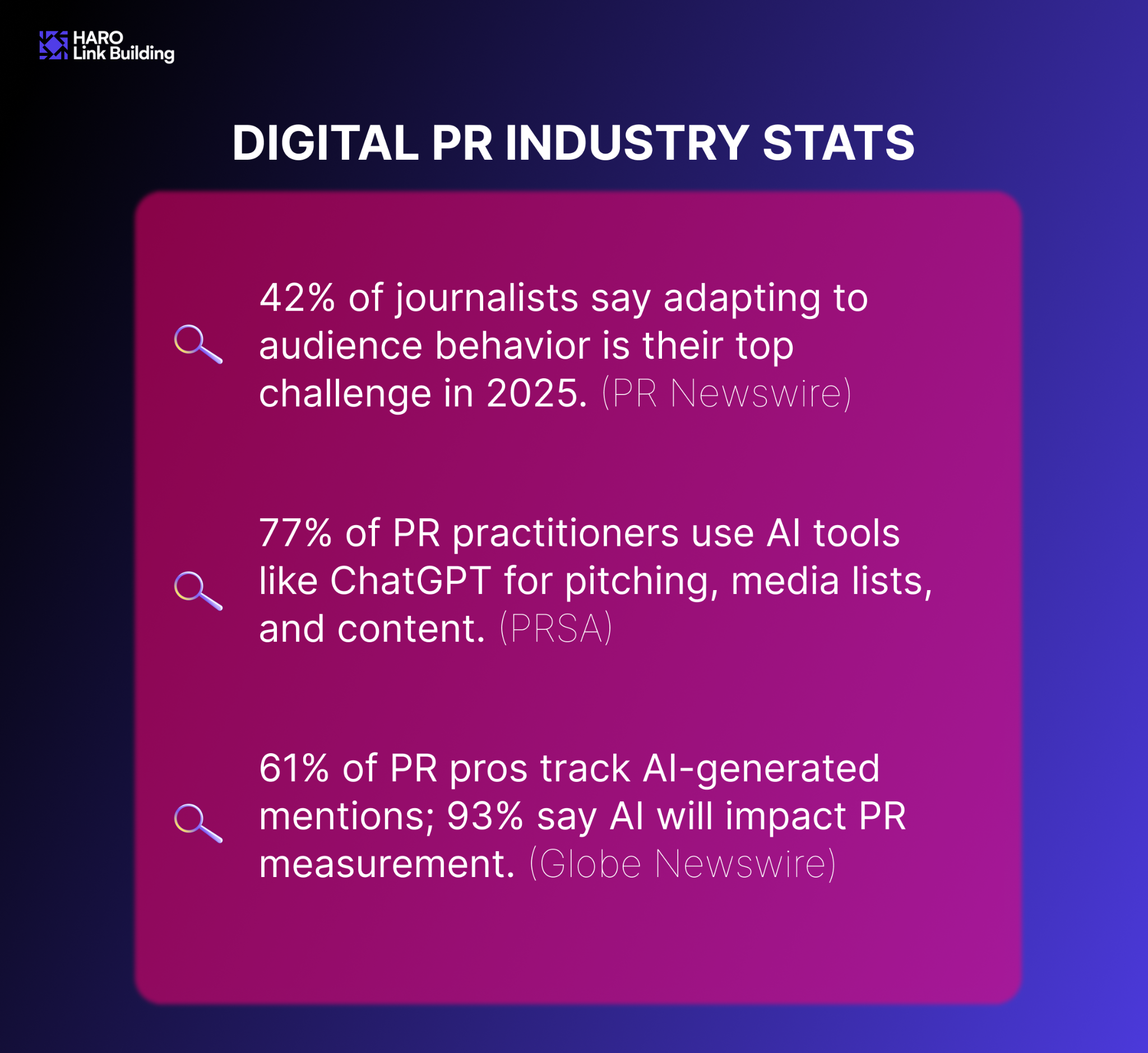
AI is becoming central to modern PR operations. 77% of PR professionals now use tools like ChatGPT for pitching, content creation, and media monitoring. This automation allows teams to build media lists faster, generate personalized pitches, and stay on top of journalist requests without being buried under repetitive tasks. (PRSA)
At the same time, PR measurement is shifting. 61% of professionals track AI-generated mentions, and 93% expect AI to influence how success is evaluated. (GlobeNewswire)
This means media outreach is now tied to measurable business outcomes like SEO benefits (in terms of backlinks), credibility to get seen by Google & people alike.
Journalists themselves are adopting the new norms. In a 2025 survey, 42% cited adapting to audience behavior as their top challenge. (PR Newswire)
They increasingly value curated, high-quality pitches over generic mass emails, making relevance and timing more critical than ever.
So if you’re leveraging platforms like HARO and Qwoted, the implications are clear. Success depends on combining reach with curation: platforms must filter spam, match expertise accurately, and help users manage outreach efficiently. Mass email blasts alone no longer cut it — targeted, strategic pitching is now the standard.
In short, 2026 is the year where technology, journalist expectations, and PR strategy intersect. Understanding these trends ensures your media outreach is efficient, measurable, and more likely to result in meaningful coverage. Platforms that adapt to these changes give you a clear advantage, whether you’re pitching at scale with HARO or targeting curated opportunities via Qwoted.
Alternatives to HARO and Qwoted
If you’re exploring other options beyond HARO and Qwoted, Featured is an obvious choice. As the company that now owns HARO, Featured offers a mix of high-volume email digests and a modern dashboard for managing pitches.
It gives you access to thousands of journalist queries while keeping some level of quality control, making it a solid option if you want exposure without losing organization.
Journo.com is another alternative, particularly strong for UK-focused campaigns. It works like Qwoted in that it provides curated journalist requests, but it’s more niche, making it ideal for startups and PR professionals targeting European media outlets.
For those focusing on regional coverage, SourceBottle is worth considering. Popular in Australia and the UK, it operates similarly to HARO but with a geographic focus, allowing you to reach local journalists and avoid competing in global query lists.
Finally, platforms like PR Newswire or PressRush aren’t exactly HARO replacements, but they provide tools for distributing press releases and connecting with journalists. These are particularly useful if you’re running larger campaigns or want to combine curated outreach with traditional press distribution strategies.
Final Verdict: What to Choose Between Qwoted vs HARO?
Choosing between HARO and Qwoted comes down to your goals, workflow, and the type of media exposure you want.
HARO is perfect if you want high-volume outreach and broad exposure across many journalist queries. It’s free, simple, and relies on familiar email digests, making it easy to jump in and start pitching immediately.
Qwoted, on the other hand, is built for curated, targeted media opportunities. Its matching system, internal inbox, and dashboard help you focus on the most relevant journalists, reducing noise and increasing the chance of meaningful placements. The trade-off is lower volume and some limitations for free users, but the quality and relevance often outweigh these drawbacks.
For most founders, marketers, and PR professionals, the smartest approach is to use both strategically: HARO for volume and discovery, and Qwoted for curated, high-intent opportunities.
Together, they give you a full-spectrum media strategy, letting you connect with journalists efficiently, build credibility, and maximize your chances of getting featured in top publications.
At the end of the day, these tools are about making your expertise visible, connecting with journalists, and building credibility.
If you want a partner that takes care of everything for you under one fixed price per link, so you never have to sift through pitches or guess what to write to get noticed by journalists, just contact us. We handle the entire process, letting you focus on what matters to you the most.
FAQs
Is HARO better than Qwoted?
Both platforms work, but they serve different workflows. HARO gives you volume with its email-based system, which is ideal if you want a steady flow of journalist requests without logging into a dashboard. Qwoted focuses on relevance and quality by matching experts to specific queries. HARO is better for high-volume opportunities, while Qwoted is stronger for curated, higher-intent pitches.
What is the main difference between HARO and Qwoted?
The biggest difference is how you receive opportunities. HARO sends bulk email digests multiple times a day, while Qwoted uses a matching system that notifies only relevant experts. HARO is faster to skim, and Qwoted is cleaner for targeted outreach. You can use both together if you want coverage from two different discovery systems.
Does Qwoted offer free access?
Yes. Qwoted has a free tier that lets you respond to journalist requests, but it comes with limits on profile features and the number of pitches. The paid plan is mainly for users who want higher visibility and more frequent matches. You can still get results on the free plan if your profile is optimized.
Is HARO still free to use?
HARO, now rebranded under Featured, still offers free access for sources. The free plan gives you daily journalist requests through email. Paid tiers exist, but you can respond to most queries without upgrading. Many businesses and founders rely entirely on the free version for media coverage.
Can I use HARO and Qwoted together?
Yes, and it actually increases your chances of getting quoted. HARO gives you broad exposure with dozens of daily queries, while Qwoted filters those down and sends only the most relevant matches. Running both platforms builds a wider media pipeline without adding much extra effort.
Which platform gives faster results?
Qwoted generally offers quicker responses because journalists see your expert card and can message you instantly inside the platform. HARO works through email, so the turnaround depends on how fast journalists sort through submissions. Most users notice that wins come faster on Qwoted, while HARO delivers volume over time.
Which platform has better journalists?
Both attract legitimate journalists, but they’re not identical. HARO has the larger pool and includes everything from global outlets to niche blogs. Qwoted’s smaller pool includes journalists who prefer a clean dashboard instead of mass digests. Brands often use HARO for volume and Qwoted for targeted, relationship-driven media.
Are HARO queries genuine and worth replying to?
Yes, but the platform includes a wider range of media types, and not every query fits every niche. You’ll get top-tier publications, mid-tier outlets, and smaller sites mixed together. As long as you filter strategically, HARO remains one of the strongest free PR tools for consistent visibility.
Is Qwoted worth paying for?
The paid plan is useful if you want more visibility, more matches, and faster communication with journalists. If you just want occasional features, the free plan works fine. If you’re building a long-term PR strategy, the paid version saves time by surfacing more relevant opportunities.
What are the best alternatives to HARO and Qwoted?
The most established alternative is Featured, which powers the new HARO. Other solid options include Terkel, Help a B2B Writer, and JournoLink. Each has different strengths like niche-specific queries, structured Q&A formats, or business-focused journalist networks.

.png)